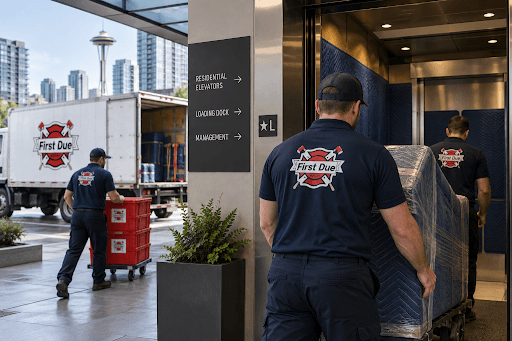
AI Summary
Moving an office in Seattle typically costs between $2,500 and $15,000, driven by square footage, building access, after-hours requirements, packing, and IT equipment. Beyond price, downtime is the biggest cost, so the post lays out building requirements (COI, freight elevator reservations, dock rules), an 8-week planning timeline, and strategies for a zero-downtime move. First Due Movers is a firefighter-founded company serving Seattle and the greater Puget Sound.
Moving an office in Seattle costs most businesses between $2,500 and $15,000, depending on square footage, building access, and how much of the packing you hand off. A small 1,000 square foot office with a few workstations usually lands between $1,500 and $3,500. A 10,000 square foot office with cubicles, server equipment, and a downtown high rise on either end can run $12,000 to $25,000.
Those are numbers we have observed from clients in the past, and we will break down exactly where you fall in that range below. But cost is only half of what makes or breaks an office move. The other half is planning, because the most expensive part of any business relocation is not the movers. It is the downtime.
First Due Movers is a firefighter-founded moving company serving Seattle, the Eastside, and South King County. We plan office moves the way we planned emergency responses: everything staged, everyone briefed, no wasted motion. Seventeen years of moving offices in Seattle have taught us what can go wrong and how to prevent it from happening to you.
How Much Do Office Movers Cost in Seattle?
Most Seattle commercial movers price office relocations one of two ways: hourly for smaller moves, or a flat project rate for anything involving multiple crews, after hours work, or specialty equipment.
| Office size | Typical cost range | Crew and timeline |
|---|---|---|
| Under 1,500 sq ft (2 to 10 employees) | $1,500 to $3,500 | 2 to 3 movers, half day to one day |
| 1,500 to 5,000 sq ft (10 to 40 employees) | $3,500 to $9,000 | 3 to 5 movers, one to two days |
| 5,000 to 10,000 sq ft (40 to 80 employees) | $9,000 to $18,000 | 5 to 8 movers, two to three days, often phased |
| 10,000+ sq ft (80+ employees) | $18,000 and up | Multiple crews, phased over nights and weekends |
These ranges assume a move within the Seattle metro. What pushes you toward the top of your range:
- After hours and weekend work. Most Seattle office buildings require commercial moves to happen outside business hours. Evening rates run 10 to 25 percent higher, but they also mean your team walks into a working office Monday morning instead of losing a business day.
- Building access on both ends. Freight elevator reservations, loading dock time limits, and long carries from dock to suite all add hours. Two high rise buildings on the same move is the most expensive access scenario in the city.
- Packing services. If your staff packs their own desks and you only need furniture, equipment, and files moved, you save meaningfully. Full packing service can add a significant amount to your total, in some cases approaching the cost of the move itself, but it eliminates the days of lost employee productivity that self-packing usually costs. For most businesses that lost time adds up to more than the packing service does.
- IT and server equipment. Servers, network racks, and multi monitor workstations need padded crating and careful sequencing so your IT team can bring systems back up in order. Budget extra crew time here rather than discovering the problem at 11 pm on move night.
What Seattle Office Buildings Require Before You Can Move
This is the section most companies find out about three days before their move, and it is the number one cause of delayed office relocations in Seattle.
- Certificate of insurance (COI). Nearly every managed office building in Seattle, and virtually every downtown high rise, requires your moving company to submit a COI naming the building owner and property manager as additionally insured before the crew is allowed in the freight elevator. Requirements commonly include $1 million per occurrence in general liability, plus auto and workers compensation coverage. Ask your property manager for their COI requirements the same week you book your movers, and send them to your moving company immediately. A legitimate commercial mover can turn a COI around in a day or two. If a mover hesitates when you ask about COIs, that tells you everything you need to know.
- Freight elevator reservations. Downtown buildings book freight elevators in blocks, often weeks out, and many only allow moves on evenings or weekends. Reserve the elevator on both your origin and destination buildings before you confirm your move date, not after.
- Loading dock rules. Some buildings limit dock time to specific windows or require dock plates and floor protection. Your movers should ask you for the building rules in advance. If they do not ask, that is a flag.
- Floor and wall protection. Masonite floor runners, corner guards, and elevator pads are standard on any professional commercial move. Buildings can and do bill tenants for damage in common areas.
Do not skip the COI conversation
The Office Move Timeline That Works Best
An office move runs on a longer clock than a residential one. Here is the planning sequence we recommend, whether you hire us or not.
- 8 weeks out. Confirm your move date with both buildings. Request COI requirements and freight elevator availability. Get quotes from commercial movers, and insist on an on site walkthrough rather than a phone estimate. Any commercial quote given without seeing your space is a guess.
- 6 weeks out. Book your mover. Assign one internal move coordinator with the authority to make decisions. Start an inventory of what is moving, what is being replaced, and what gets decommissioned or donated. Moving furniture you are about to throw away is the most common money leak in office relocations.
- 4 weeks out. Order internet and phone service at the new space now. Telecom lead times sink more office moves than any moving company ever has. Give your IT team the new floor plan so they can map network drops to desks.
- 2 weeks out. Distribute labeled crates or boxes to employees with a simple system: every box gets a name and a destination room number matching the new floor plan. Confirm elevator reservations and COI approvals in writing with both buildings.
- Move week. Employees pack personal items and desk contents by end of day before the move. IT powers down and disconnects in a documented order. Movers handle furniture, equipment, files, and boxed IT gear. IT reconnects at the new site following their documentation, in reverse.
- Day one in the new office. Your move coordinator and your moving company do a walkthrough together. Anything missing, damaged, or in the wrong room gets logged and resolved that day.
How to Move an Office Without Losing a Business Day
The businesses that pull off zero downtime moves all do the same three things.
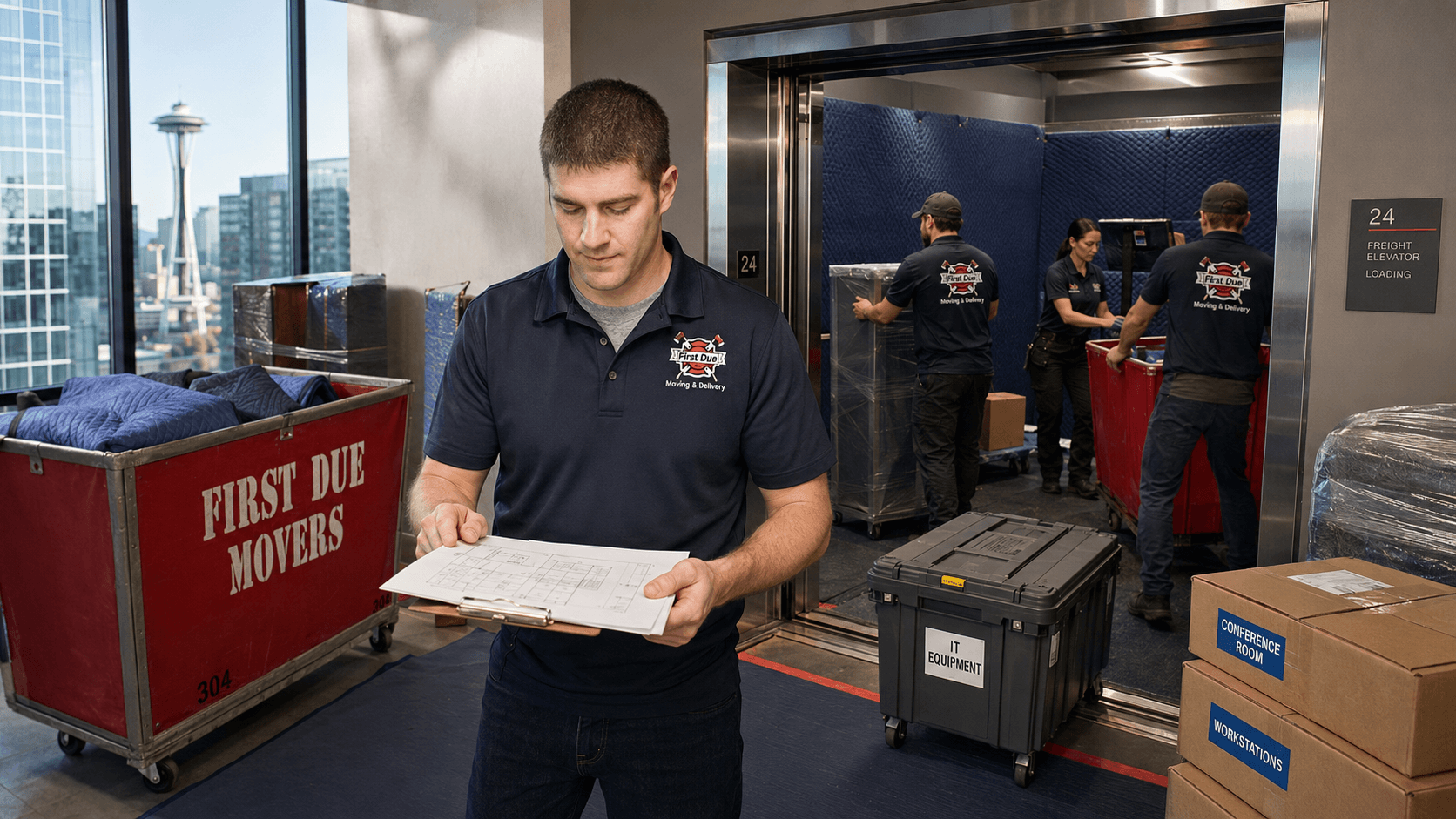
First, they move on a Friday night or over a weekend, with IT scheduled to rebuild over Saturday and test on Sunday. Second, they phase anything over about 5,000 square feet: departments move in waves so the business never fully stops. Third, they treat the floor plan as the master document. Every box, chair, and monitor is labeled to a room number on the new floor plan, so the crew never has to stop and ask where something goes.
That last one sounds small. It is the difference between a crew that finishes at 9 pm and a crew that finishes at 2 am on your invoice.
Why Seattle Businesses Hire a Firefighter-Founded Moving Company
First Due Movers was founded and is staffed by firefighters and first responders. That is not a marketing angle, it is an operating advantage on a commercial move.
Fire crews run on checklists, pre-planning, and accountability for every piece of equipment on a rig. We run office and commercial moves the same way: a written plan before move night, a crew brief before anyone touches a desk, and an inventory check before we leave. Our clients also tend to appreciate that every person walking through their office passed the background standards required to serve in the fire service.
We handle office and commercial moves across Seattle, Bellevue, Kirkland, Kent, Renton, Issaquah, Tacoma, and the greater Puget Sound, including after hours and weekend moves, packing services, and short term storage between lease dates.
Frequently Asked Questions
How far in advance should I book office movers in Seattle?
Six to eight weeks for most offices, and longer if you need a specific weekend or you are moving in the summer, which is peak season. Small offices can sometimes book two to three weeks out, but freight elevator availability at your buildings is usually the real constraint, not the moving company.
Do office movers work nights and weekends?
Yes, and in Seattle it is the norm rather than the exception. Most managed buildings require it, and most businesses prefer it so they do not lose working hours. Expect a modest premium for after hours crews.
Can movers handle our IT equipment and servers?
Professional commercial movers crate and transport servers, racks, monitors, and workstations. Disconnecting and reconnecting your network should be done by your IT team or IT vendor, working alongside the movers on a documented sequence. Coordinate the two schedules early.
What happens to furniture we do not want to take?
Ask about decommissioning. Good commercial movers can deliver unwanted furniture to liquidators, donation partners, or recycling instead of the landfill, and doing it during the move is far cheaper than a separate haul out later.
Do we need moving insurance beyond the COI?
The COI protects the buildings. Your goods are covered by the mover's valuation coverage, and basic released valuation is minimal, typically 60 cents per pound. For offices with significant equipment, ask about full value protection or check whether your business property policy covers goods in transit.
How do I get an accurate quote for an office move?
Insist on a walkthrough. A commercial estimator should see your space, count workstations, check elevator and dock access, and ask about your new building's requirements before giving you a number. Get the quote in writing with the crew size, hours, and what is and is not included.
Ready to Plan Your Office Move?
Get a free on site walkthrough and a written quote from First Due Movers. Firefighter-founded, Seattle based, and built for moves where downtime is not an option. Contact us or call to schedule your walkthrough.
Written by
Jacob Axelson
Moving Specialists
The First Due Movers team brings firefighter values to every move — integrity, professionalism, and care for our customers and community.